

Welcome to Training Tip Tuesday, where I explore a different training focus each week—from strength and cardio to flexibility and balance.

Today’s Training Tip
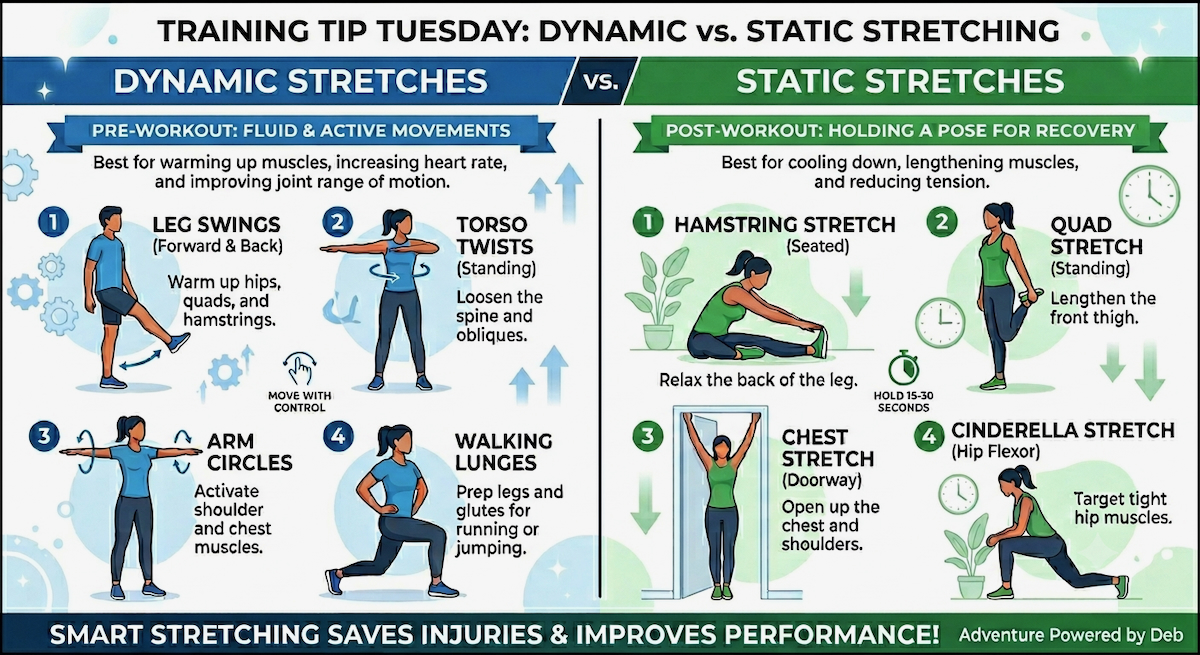
Always perform dynamic stretching before your workout to prep your body, and save static stretching for afterward to aid in recovery.
The Difference Between Dynamic and Static Stretching
Dynamic stretching involves fluid, controlled movements that take your muscles and joints through their full range of motion without stopping. By boosting your heart rate and increasing circulation, this active warmup primes your body and prepares you for an optimal workout.
Static stretching involves easing a muscle into an elongated position without any bouncing, holding it at the point of gentle tension for 15 to 30 seconds. This method is designed to relax the muscles, reduce post-workout stiffness, and gradually improve your overall flexibility and range of motion over time.
Why You Shouldn’t Start with Static Stretches
It’s a very common fitness misconception to hold deep, static stretches before you exercise. In reality, stretching cold muscles can actually increase the risk of injury. Instead, save those long holds for the post-workout cooldown when the body is warm and ready to recover. Before your workout, stick to dynamic stretches to get the blood flowing and safely prime your muscles for movement.
Examples of Dynamic Stretches
Try these dynamic stretches to take the muscles and joints through controlled full range of motion movements.
- • Walking lunges – targets glutes, quads, hamstrings, and hip flexors
- • Reverse airplanes – targets glutes, hip rotators, and lower back
- • Standing cross-overs – targets hip flexors, hamstrings, glutes, and lower back
- • Leg swings – targets hips, hamstrings, and quads
- • Torso twists – targets spine, core, and obliques
- • Arm circles – targets shoulders, chest, and upper back
- • Inchworms – targets hamstrings, calves, lower back, core and shoulders
- • High knees – targets hip flexors, glutes, and lower back
- • Butt kicks – targets quads and hip flexors
- • Toy soldiers – targets hamstrings and hip flexors
Examples of Static Stretches
Use static stretching to hold the muscle group in each stretch for 15-30 seconds.
- • Seated hamstring – targets hamstrings and lower back
- • Standing quad – targets quads and hip flexors
- • Butterfly – targets adductors and hips
- • Childs pose – targets lower back, shoulders, and hips
- • Cobra – targets abs and chest
- • Doorway chest – targets pecs and anterior deltoids
- • Standing calf – targets gastrocs and soleus
- • Figure-four – targets glutes, outer hips, and piriformis
- • Overhead triceps – targets triceps and upper back
- • Cross-body – targets posterior deltoids and upper back
Questions
- • What’s your go-to dynamic stretch to wake up your muscles? ~ mine for strength training is walking lunges and arm circles
- • Which do you enjoy more, dynamic or static stretching? ~ dynamic
- • How many minutes do you usually spend stretching? ~ not enough 😉
These are great tips, Debbie!
I do dynamic stretching before every run and in the evening, I have a standard 15-minute stretch that I follow along on a video.
My favourite stretch is the “World’s greatest stretch”, where you start in a low lunge position and rotate your arm to the ceiling.
Thanks, Catrina! It sounds like you have a solid routine in place with both your dynamic pre-run stretches and your static evening sessions.
I definitely prefer dynamic stretching, but static is much more relaxing. I do a lot of high knees & butt kicks before I head out for a run. Also walking lunges (when I remember, LOL).
Same! I think dynamic stretching fits better with both of our “always doing something – have trouble to chilling” personalities. 😉
I only do dynamic stretches, some of those you mentioned as static stretches I do in a dynamic form, as soft movements into full ROM and not holding more than 2-3 seconds. I do a lot more stretching now than I used to and my body seems to like it. The figure-four is my go-to but also airplanes and another hip rotation, and I do a shoulder rotation variant. For warm-up I do a variety of things depending on what exercises are planned, but inchworms and wall slides are very frequent.
That’s awesome, Susanne! Most of the Peloton instructors do figure 4 stretches during their post-ride stretching class. Those are great – I’d never done them standing until taking Peloton classes, but they work great that way, too.
I do a mobility routine before I run (usually) which sounds like the same as dynamic stretching. I definitely don’t do enough static stretching though. A lot of days I’ll do yoga later in the day, but I need to be more consistent with that. Thanks for the reminder!
Good to hear, Jenny! So many of us just don’t do enough stretching and Peloton has really helped me improve on that.